


I’ll be honest.
Part of me wants to end this series with a home run. Something sharp. Decisive. A clear line that makes people nod and say, “That’s it.”
The addict in me still likes a big swing.
But that might be the problem.
Years ago, after a meeting, another guy in recovery and I were sitting in a Denny’s. Fluorescent lights. Cheap coffee. Nothing glamorous.
We were laughing. Not high. Not ecstatic. Just… good.
Which was remarkable, because when we were using, we rarely felt good like that unless we were using.
We asked each other, “How do you explain this to someone still drinking? When they ask, ‘So what do you do for fun now?’”
Our answer?
“We go have coffee.”
We laughed because we knew how lame that would sound to someone chasing a high.
But for us, it was nothing short of miraculous.
We had found peace in something ordinary.
And maybe that’s where this lands.
Not in a dramatic solution.
Not in a political masterstroke.
Not in a rhetorical home run.
But in something steadier.
In Part One, I wrote about exhaustion—how the world feels stretched too far for too long.
In Part Two, I wrote about the instinct to grab the wheel when things feel unstable.
If exhaustion is the smoke, control is the reflex.
The planet warms. Wars continue. Racism persists. Power concentrates. Economic anxiety lingers. Institutions wobble. Headlines hit our phones before coffee.
It feels so unmanageable.
And when life feels unmanageable, the instinct is predictable:
Take control.
Fight back.
Double down.
Make something happen.
That reflex isn’t evil.
It’s human.
It’s what Adam and Eve were reaching for—control, wanting to be like God.
It’s what the disciples kept pushing Jesus to do—take control.
And it’s what I feel in my own body when the news spikes my nervous system—react.
In recovery we say, “We admitted we were powerless over alcohol and that our lives had become unmanageable.”
What if control is the deeper addiction? The ultimate thing we are powerless over?
Not just political dominance. Not just power grabs. But the belief that if I can just secure the right outcome, I’ll finally feel safe.
But no one can hold the world together.
Not governments.
Not movements.
Not churches.
Not me.
And whenever I try, something tightens inside me. I become reactive. Less generous. More anxious. More like the very forces I say I’m resisting.
There’s a moment in the gospels when Peter steps out of the boat in the middle of a storm. The wind is strong. The water is wild.
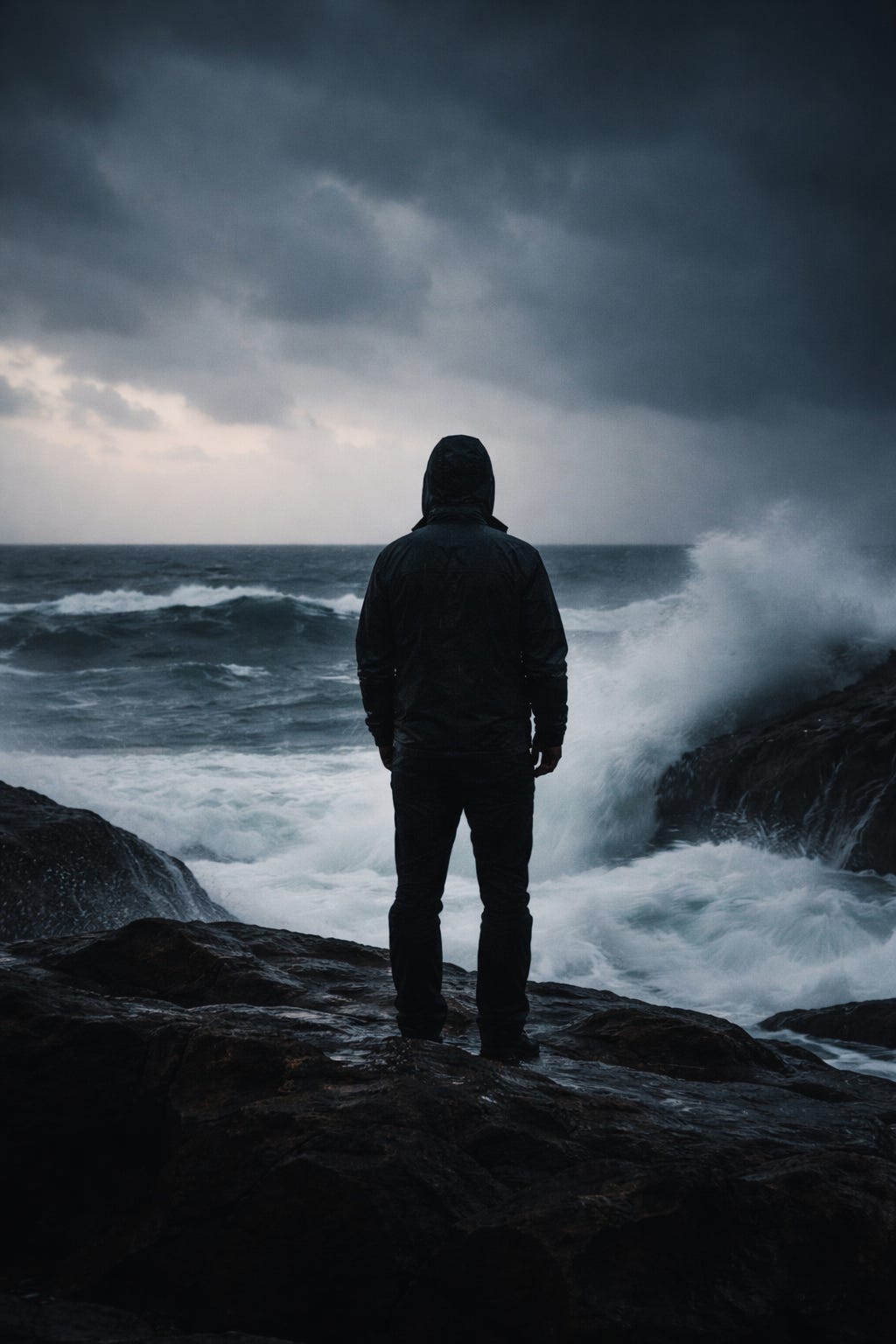
For a moment, he walks above it.
But then he notices the wind and the waves.
Fear overtakes him and he starts to sink.
The storm didn’t get worse.
His focus changed.
That detail matters.
The chaos we’re living in is real. But we are also staring at it constantly. Before we get out of bed, the storm is in our hands. Notifications. Breaking news. Orange outrage.
We don’t just live in the storm.
We fix our eyes on it.
And we start to sink.
And when all you look at is wind and waves, sinking makes sense.
I can’t calm the wind. I can’t control geopolitics. I can’t fix Washington. I can’t eliminate injustice.
But I can decide what holds my attention.
If my attention is owned by fear, I will be ruled by fear.
If my attention is anchored in something steadier—something bigger than the crisis of the hour—I don’t have to sink. I can rise above it.
That doesn’t make me passive.
It makes me sane.
It doesn’t mean I do nothing, but I act instead of react.
I don’t get to choose the times I live in.
But I do get to choose whether fear will decide who I become.
For now, that feels like enough.
“But when he noticed the strong wind, he became frightened, and beginning to sink, he cried out, ‘Lord, save me!’
Jesus immediately reached out his hand and caught him.”
— Matthew 14:30–31 (NRSV)
What has been holding your attention lately--wind and waves, or something more powerful?
God of calm in the middle of storms,
when fear pulls at us and chaos fills our vision,
steady our gaze.
Help us loosen our grip on what we cannot control
and anchor ourselves in what is deeper and truer than the headlines.
Teach us to act without panic,
to resist without hatred,
and to remain human in a world that feels unmanageable.
Amen.
The Elephant Chronicles are meditations based on my upcoming book “The Lie that Kills Us: We All Have Elephants.” It explores the elephants we avoid: denial, addiction, trauma, death, and grace.
If you’d like me to let you know when it’s released, send a note to: Pastored@addictionandfaith.com
I’d be honored to keep you in the loop.
The book is available now: Amazon

This fits me to a "T" and I'm so grateful for my recovery that helps me to focus on that strength.